Low Bunk Beds, Overall Height Less then 62
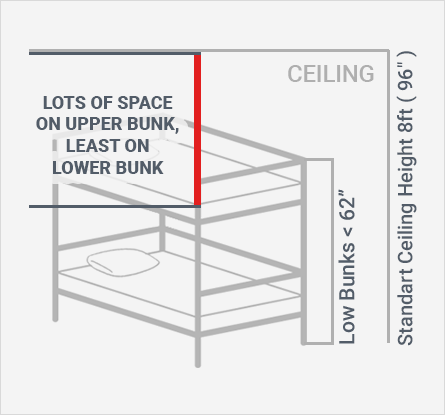
Lower the bunk, more comfort on top and less on bottom
Standard ceiling height in Canada is 8 feet or 96 inches.
Some places, like older basements or attics, are lower in height.
Our lowest height bunk bed is 65” high.
Lower the height of your bunk, more room you have on upper bunk and of course less on lower bunk.
Usage:
If you ceiling height is less than standard.
If you have one child and like to leave lower bunk for sleep overs.
If you worry about changing sheets, or falling, or simply just feeling more comfortable with lower height bunk bed with no rim or reason.
Some places, like older basements or attics, are lower in height.
Our lowest height bunk bed is 65” high.
Lower the height of your bunk, more room you have on upper bunk and of course less on lower bunk.
Usage:
If you ceiling height is less than standard.
If you have one child and like to leave lower bunk for sleep overs.
If you worry about changing sheets, or falling, or simply just feeling more comfortable with lower height bunk bed with no rim or reason.
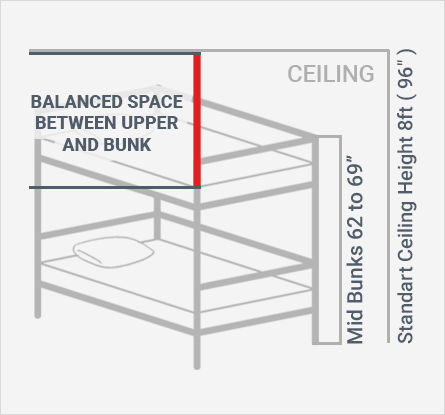
Medium Height Bunk Beds, Overall Height 66” to 70”
This height range is the most common height range. Both upper and lower bunk have reasonable space. Please note that you can have two bunk bed with same height, but one with less space on lower bunk compare to the other. This is because there is no standard on where to put mattress rails. Some design objective is a lot of space for storage under the bunk, and so on.
Usage:
Just about anyone, anywhere, anyhow! The Goldilock of sizes.
Usage:
Just about anyone, anywhere, anyhow! The Goldilock of sizes.
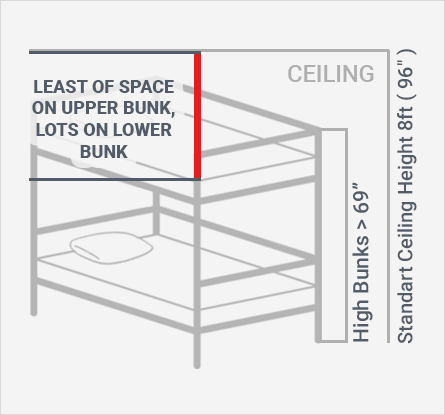
High Height Bunk Beds, Overall Height from 71” to 73”
This height range is on high side of spectrum but still fine for standard eight foot ceiling.
Usage:
If you prefer a lot of space on lower bunk.
If you are looking into Queen size bunks, higher the height the better. Reason is that usually parents get to sleep on lower bunk and need more headroom, and kids get to sleep on upper bunk.
If your ceiling height is more than standard eight feet.
Usage:
If you prefer a lot of space on lower bunk.
If you are looking into Queen size bunks, higher the height the better. Reason is that usually parents get to sleep on lower bunk and need more headroom, and kids get to sleep on upper bunk.
If your ceiling height is more than standard eight feet.